Opium production in Myanmar nearly doubles over past 2 years under junta, UN finds*
:0:0
Opium production in Myanmar has nearly doubled since the military coup two years ago, a U.N. report found Thursday, reversing years of declines, as farmers devote more land to growing poppies amid economic turmoil and disruptions.
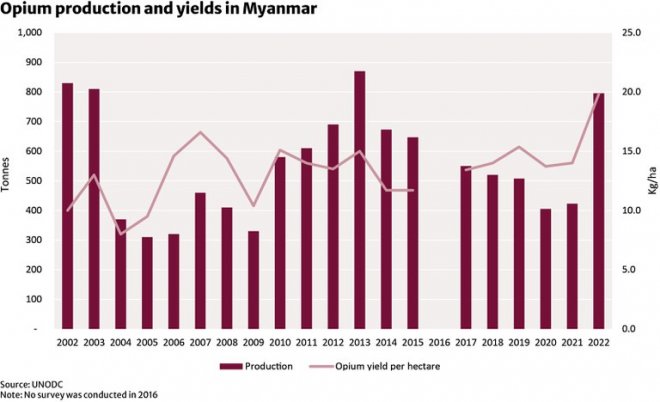
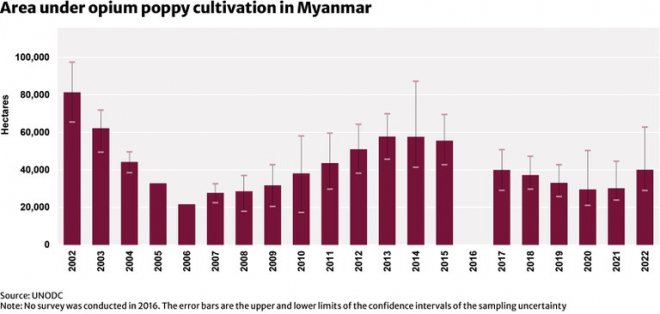
Estimated potential opium production surged 88% to 790 metric tons in 2022 after having fallen to 400 metric tons in 2020 from 870 metric tons in 2013, the U.N. Office on Drugs and Crime found.
The area of poppy cultivation, meanwhile, expanded 33% to more than 40,000 hectares from a year earlier. Production increases were most pronounced in eastern Shan state, which accounted for 84% of the total estimated area of poppy cultivation, the report said.
Poppies, which can be processed into heroin, are a lucrative crop for farmers desperate to earn money amid the political and economic chaos following the Feb. 1, 2021, military coup. Fresh opium prices jumped 62% and dry opium rose 69%, and farmers are estimated to have earned more than twice as much as the previous year to as much as U.S.$350 million, the report said.
“Economic, security and governance disruptions that followed the military takeover have converged, and farmers in remote, often conflict-prone areas in northern Shan and border states have had little option but to move back to opium,” UNODC Regional Representative Jeremy Douglas said in a statement accompanying the release of the report.
Myanmar is the world’s second-biggest producer of heroin, and the source of most of Southeast Asia’s methamphetamine. Most of the drugs are produced in border regions, outside of government control.
A man lances a poppy in an opium poppy field in Myanmar’s Shan state, Feb. 3, 2019. Credit: AFPImpact on wider Mekong region
The resurgence of poppy cultivation and production will have a significant impact on the wider drug economy in the lower Mekong region, the U.N. agency warned. It called for a strengthening of the economic resilience and basic livelihoods of farming communities to counter the renewed momentum.
The report attributed the growth to increased size of fields and the detection of “poppy hotspots,” where the crop could thrive, compared to typically small, poorly organized poppy plots with low cultivation density in the past. It also said more sophisticated farming techniques and concentration of production also played a role in the change, as did decreased eradication efforts.
The average opium yield in 2022 swelled 41% to 19.8 kilograms per hectare over 2021, the report said, making it the highest yield estimate since the beginning of systematic yield surveys in 2002.
“Taken together, it appears that year-over-year declines in poppy cultivation and opium production in Myanmar, which started in 2013, ended around 2020,” the report said.
Douglas predicted that the increases in cultivation and production will continue unless Myanmar becomes more stable.
“At the end of the day, opium cultivation is really about economics, and it cannot be resolved by destroying crops which only escalates vulnerabilities,” he said. “Without alternatives and economic stability, it is likely that opium cultivation and production will continue to expand.”
Douglas told Radio Free Asia that not only the production of opium and heroin is up in Myanmar, but methamphetamines as well.
Responding to UNODC’s findings, Nay Phone Latt, the spokesman of Myanmar’s shadow National Unity Government, told RFA that junta chief Sr. Gen. Min Aung Hlaing “isn’t interested in anything other than the perpetuation of his power.”
He suggested that Min Aung Hlaing has little incentive to curb opium production in the country because “he and his family members are enjoying the benefits of the drug trade.”
Though technically illegal in Myanmar, opium cultivation for the manufacture of heroin has been tolerated and even taxed by corrupt officials in the Myanmar military, the Myanmar Police Force and rebel ethnic armies.
Translated by Myo Min Aung. Edited by Joshua Lipes and Malcolm Foster.








 Poppies, which can be processed into heroin, are a lucrative crop for farmers desperate to earn money amid the political and economic chaos following the Feb. 1, 2021, military coup. Fresh opium prices jumped 62% and dry opium rose 69%, and farmers are estimated to have earned more than twice as much as the previous year to as much as U.S.$350 million, the report said.
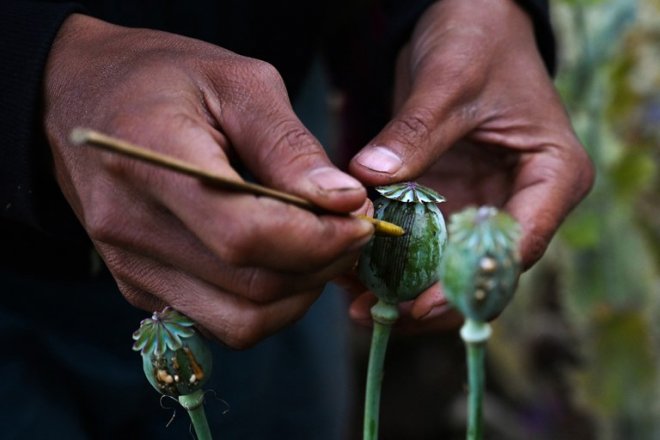 A man lances a poppy in an opium poppy field in Myanmar’s Shan state, Feb. 3, 2019. Credit: AFP
 Impact on wider Mekong region
 Responding to UNODC’s findings, Nay Phone Latt, the spokesman of Myanmar’s shadow National Unity Government, told RFA that junta chief Sr. Gen. Min Aung Hlaing “isn’t interested in anything other than the perpetuation of his power.”