Japan’s plan to discharge water from Fukushima nuclear plant faces Pacific opposition*
Officials from Pacific island nations will meet Japan’s prime minister in March in an effort to halt the planned release of water from the tsunami-damaged Fukushima Daiichi nuclear plant into the Pacific Ocean, a regional leader said.
Plans to dispose of Fukushima water over four decades are a source of tension between Japan and Pacific island nations and a possible complication for the efforts of the United States and its allies to show a renewed commitment to the Pacific region as China’s influence grows.
The planned discharges “are a very serious issue that our leaders have accepted must be stopped at all costs,” Henry Puna, secretary-general of the 18-nation Pacific Islands Forum, said Thursday at a press conference in the Solomon Islands capital Honiara.
The Japanese government’s timetable for disposal of Fukushima water indicates that releases could begin as soon as April this year – part of an effort to decommission the stricken power station over several decades. Water contaminated by the nuclear reactors damaged in a 2011 tsunami is stored in dozens of large tanks at the coastal Fukushima plant.
Japan’s method involves putting the contaminated water through a purification process known as the Advanced Liquid Processing System, which it says will reduce all radioactive elements except tritium to below regulatory levels. The treated water would then be diluted by more than 100 times to reduce the level of tritium – radioactive hydrogen used to create glow-in-the-dark lighting and signs.
Japanese authorities and the Fukushima plant operator, Tokyo Electric Power Company, have said radiation released into the ocean would be a minute fraction of naturally occurring radiation in the environment.
The International Atomic Energy Agency, a U.N. agency which describes itself as promoting safe use of nuclear energy, has said the Fukushima process is technically feasible and in line with international practice.
Pacific island leaders are unconvinced the discharges will be safe and some scientists have called for the Fukushima plant to continue storing treated water on site rather than releasing it.
Japan has said storage space is running out as an Olympic swimming pool’s worth of radioactive water is generated about every two weeks from water used to cool reactor fuel debris and groundwater contamination.
Data doubts
Five scientists working with the Pacific Islands Forum last week criticized the quality of data they had received from Tokyo Electric on the treated water in the tanks and expressed doubts about how well the purification process works.
Over more than four years, only a quarter of tanks had been tested for radiation, and testing rarely covered more than nine types of radiation out of 64 types that should be tested for, said the five scientists, who include Woods Hole Oceanographic Institution’s senior scientist Ken Buesseler.
“The accident is not over; this is not normal operations for a reactor. Therefore, extraordinary efforts should be made to prove operations are safe and will not cause harm to the environment,” the scientists’ presentation said.
The Pacific Islands Forum has described the scientists as independent nuclear experts. The forum’s secretariat didn’t respond to a question about whether the scientists are compensated for their work with the forum.
Nigel Marks, a materials scientist at Australia’s Curtin University and former nuclear reactor engineer, who is not advising the forum, said he is sympathetic to concerns that Tokyo Electric’s data could be more complete.
“But at the same time some recognition for Japan’s unique situation must be acknowledged,” he said. “The authorities have done their very best that technology allows. Eventually they reach a point where there is too much water to store.”
Puna said the Pacific islands delegation would meet with Japanese Prime Minister Fumio Kishida around March 7. They want a delay in water releases, at the very least, while more research is carried out, he said.
“There are serious gaps in the scientific evidence on the safety or otherwise of the proposed release,” Puna said. “I am pleased that the Japanese prime minister has finally agreed to meet with a high level delegation from our region.”
Decades of Fukushima water discharges, Puna said, could “damage our livelihoods, our fisheries livelihoods, our livelihood as people who are dependent very much and connected to the ocean in our culture and identity.”
![]()
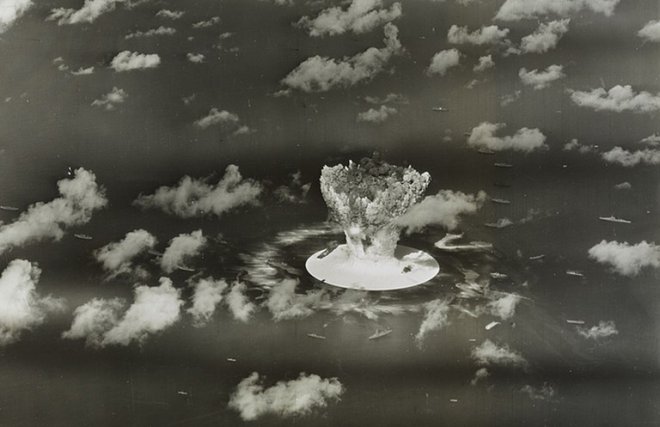
A mushroom cloud rises during the Operation Crossroads nuclear weapons test on Bikini Atoll, Marshall Islands in 1946. Credit: Reuters/U.S. Library of Congress/Handout via Reuters
Mihai Sora, a Pacific analyst at Australia’s Lowy Institute, said it’s hard to imagine a more alarming proposition for Pacific island nations given the “toxic legacy” of nuclear weapons testing and waste dumping in the Pacific.
“The timing, amidst regional geopolitical competition that has traditional powers falling over themselves to demonstrate who’s a better partner to the Pacific, could scarcely be worse,” Sora said.
The United States, United Kingdom and France carried out more than 300 nuclear detonations in the Pacific from 1946 to 1966, according to the International Disarmament Institute at Pace University in New York, which exposed thousands of military personnel and civilians to radiation and made some atolls uninhabitable.
“Decades of hard-won regional goodwill towards Japanese Pacific engagement are at risk with this single policy initiative,” Sora said.
Australia’s Department of Foreign Affairs and Trade said it welcomes Japan’s commitment to a thorough scientific assessment to ensure there are no adverse environmental and health effects. Australia is a member of the Pacific Islands Forum.
A State Department spokesperson said the United States welcomes Japan’s continued openness as it “prepares to disperse the treated water in a manner that appears to be in line with internationally accepted nuclear safety standards.”
Japan’s embassy in Suva, Fiji didn’t respond to a request for comment.
BenarNews is an RFA-affiliated news service.
 | 喜歡這篇嗎?快分享吧! |
前一頁
後一頁






 A mushroom cloud rises during the Operation Crossroads nuclear weapons test on Bikini Atoll, Marshall Islands in 1946. Credit: Reuters/U.S. Library of Congress/Handout via Reuters