Funeral homes operating around the clock in COVID-hit Beijing: employees*
Funeral homes in Beijing are operating around the clock amid a surge of COVID-19 cases, with cremations now backed up for at least five days, funeral parlor staff told Radio Free Asia on Wednesday.
An employee at the city"s Dongfang Hospital, which is attached to the University of Traditional Chinese Medicine, said via a social media post that the hospital is now having to wait five to seven days before sending human remains for cremation.
"Due to a number of positive tests among funeral home employees over the past couple of days, there is now a serious staff shortage," the post read. "And due to the recent increase in death rates in Beijing, cremations are now being scheduled for 5-7 days" time. There is a serious issue with the backlog of human remains."
An employee who answered the phone at Beijing"s Babaoshan Crematorium on Wednesday said the funeral home is now working nonstop to meet increased demand for cremations.
"We are very busy right now, with a lot of cremations happening every day," the employee said.
Asked how the backlog could build up to such an extent when the crematorium has access to several furnaces, she replied: "It doesn"t matter how many furnaces there are; there is a lot of business and we are running them 24 hours, with cremations going on through the night."
She said the earliest cremation slot was currently at 3.00 a.m. on Dec. 19.
Hearses lined up
A video clip uploaded to Twitter showed a number of hearses waiting in line, reportedly to get into the Babaoshan Crematorium, while a Weibo user said she had called around a number of funeral homes since her father died, only to find that none of them had cold storage facilities available.
According to an article on the Beijing municipal bureau of civil affairs website, Baobaoshan had 19 cremation furnaces in 2017, with daily cremations at the site averaging around 70 per day.
The city government"s official website cited civil affairs bureau director Li Hongbing as saying in 2019 that Beijing"s 12 funeral parlors own around 90 incinerators, and typically carried out an average of 300 cremations a day at that time.
According to three responses on the Baidupedia question-and-answer site and a July 13, 2022, feature article on the Netease web portal, a cremation typically takes anywhere from 25-40 minutes, suggesting a total capacity of more than 30 cremations in 24 hours for a single incinerator, and more than 3,000 if all 90 furnaces were operating simultaneously across the city.
![]()
Medical staff move a patient into a fever clinic at Chaoyang Hospital in Beijing, Tuesday, Dec. 13, 2022. Credit: Screenshot from Reuters TV via Reuters
An employee who answered the phone at the Tongzhou Funeral Parlor in Beijing said they are operating with a similar backlog.
"There"s now a waiting list of five or six days," the employee said. Asked if the furnaces were running 24 hours a day, they replied: "Yes."
An employee who answered the phone at the Chaobai Cemetery said they had received a large number of inquiries in recent days from people wanting to use their funeral home and cold-storage facilities.
"I received a lot of calls this morning asking about our funeral home [services]," the employee said, but said cemetery plots were in short supply. "We released a batch in October and they"re already sold out.”
Taiwan"s Central News Agency reported on Wednesday that there has been a recent spike in deaths of elderly people in Beijing amid the current COVID-19 wave, which comes after the ruling Chinese Communist Party loosened many of its disease control and prevention protocols following mass anti-lockdown protests.
The report said the agency had confirmed with an employee that Beijing"s Tsinghua University had recently published more than 10 obituaries of retired faculty members from Dec. 5-9 alone, while Peking University reported similar numbers of deaths on its website during the same period.
Chinese health ministry officials said the true scale of COVID-19 infections in China is now “impossible” to track without the widespread tracing and testing seen under the now-abandoned zero-COVID policy.
"Many asymptomatic people are no longer participating in nucleic acid testing, so it is impossible to accurately grasp the actual number of asymptomatic infected people," the National Health Commission said in a statement on Wednesday.
Vice premier Sun Chunlan had earlier warned that new infections in Beijing were "growing rapidly," Agence France-Presse quoted state media as saying.
Translated by Luisetta Mudie. Edited by Malcolm Foster.
 | 喜歡這篇嗎?快分享吧! |
前一頁
後一頁










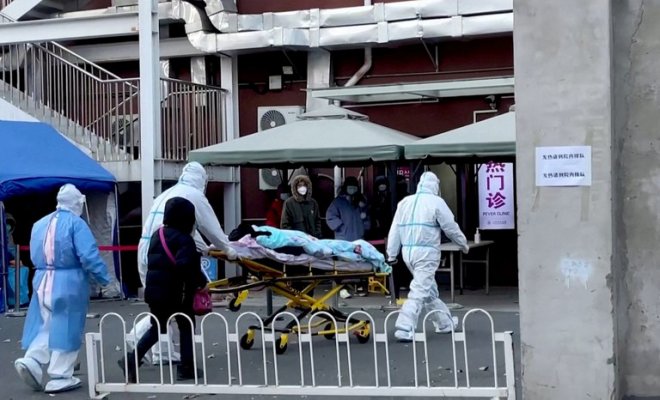 Medical staff move a patient into a fever clinic at Chaoyang Hospital in Beijing, Tuesday, Dec. 13, 2022. Credit: Screenshot from Reuters TV via Reuters