Vietnam-ROK partnership may spur S. Korean investment and arms sales*
Vietnam and the Republic of Korea have launched a special partnership, the first of its kind the communist country has established with a U.S. treaty ally.
The so-called comprehensive strategic partnership was launched on Monday during a trip by the Vietnamese president to the ROK (commonly known as South Korea).
President Nguyen Xuan Phuc is on a state visit at the invitation of South Korean President Yoon Suk-yeol from Dec. 4 to Dec. 6.
A comprehensive strategic partnership is generally understood as a relationship based on a high level of mutual trust, common interests and shared values.
Until now, Vietnam has only recognized three nations as its comprehensive strategic partners: China, Russia and India. All three have a long history of supporting the communist North Vietnam, especially during the Vietnam War.
South Korea took an active part in the war, sending hundreds of thousands of soldiers to fight alongside U.S. troops. Korean troops were accused of committing numerous atrocities during wartime and civil groups in both countries have repeatedly called for a formal investigation into the Korean forces’ actions in Vietnam.
Hanoi forged a long-standing relationship with the Democratic People"s Republic of Korea (DPRK), or North Korea, which provided North Vietnam with significant economic and military assistance.
Meanwhile Vietnam-China ties have suffered from a period of tension and mistrust as Beijing launched a brief but bloody Sino-Vietnam border war in 1979 and is embroiled in a territorial dispute with Hanoi in the South China Sea.
Shared vision
Analysts say, despite the war legacy, Seoul and Hanoi have much in common in terms of strategic vision.
“As growing middle powers in the Asia-Pacific region, South Korea and Vietnam have been targeted and induced by both Washington and Beijing,” said Huynh Tam Sang, a lecturer at Vietnam National University.
However, in Sang’s opinion, both countries favor strategic autonomy and have “sought a delicate balance between the two great powers.”
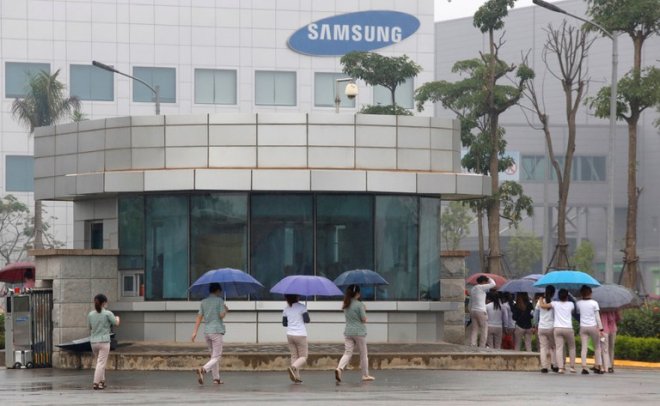
In recent years, South Korea has become one of the closest business partners of Vietnam and leading conglomerates including Samsung, SK, LG, Lotte, and Hyundai all have expanded their production there.
To date, South Korean companies have poured more than U.S.$80.5 billion into Vietnam and Seoul remains Vietnam"s largest foreign investor, according to the Vietnamese Ministry of Planning and Investment.
On Tuesday President Phuc held a meeting with Samsung Electronics Vice President Han Jong-hee, during which Han said his company plans to increase its investment in Vietnam to U.S.$20 billion.
Samsung has already invested U.S.$18 billion in Vietnam and contributes one fifth of Vietnam"s total exports.
![]()
Employees make their way to work at the Samsung factory in Thai Nguyen province, north of Hanoi, Vietnam Oct. 13, 2016. CREDIT: Reuters/Kham
Defense hardware
With the upgrading of the Vietnam-Korea partnership, the bilateral cooperation in the defense industry may also shift as Vietnam tries to diversify away from Russia, said Zachary Abuza, a professor at the U.S. National War College.
South Korea donated two of its retired Pohang-class corvettes and in the future may transfer more decommissioned vessels to the Vietnamese Navy, currently in urgent need of modernizing its aging fleet.
The corvettes are being upgraded into anti-submarine warfare ships and Hanoi is also seeking to purchase fighter jets from Seoul, according to Abuza.
The Vietnamese Air Force has so far been dependent on Soviet and Russian hardware.
“Right now, Russia is unable to deliver despite its price. South Korea offers Vietnam a fairly affordable next generation fighter jet, the KF-21, that would also work to diversify their arms supply chains,” Washington-based Abuza told RFA.
A KF-21 costs between U.S. $80-100 million, roughly the same price as a Russian Su-35 fighter.
At the moment, bilateral military industrial cooperation remains low but if South Korea agreed to some technology transfer and joint production, “there could be a greater movement there,” Abuza said.
In the official joint declaration after the meeting between Nguyen Xuan Phuc and Yoon Suk-yeol, the two leaders emphasized their commitment to fostering cooperation in defense, maritime security, policing and technology including in the defense industry.
In East Asia besides South Korea, Vietnam also has a strong partnership with Japan. Yet by choosing to elevate ties with Seoul instead of Tokyo, Vietnam wanted to “avoid unnecessary skepticism from China,” said Huynh Tam Sang from Vietnam’s National University.
“As Japan forges ties with the U.S. while being critical about China’s assertive diplomacy, upgrading ties with Tokyo could draw Hanoi into a delicate and unpleasant position,” Sang said, adding that for Hanoi leaders “this move should be avoided.”
 | 喜歡這篇嗎?快分享吧! |
前一頁
後一頁




 Employees make their way to work at the Samsung factory in Thai Nguyen province, north of Hanoi, Vietnam Oct. 13, 2016. CREDIT: Reuters/Kham