Japan on high alert as PLA Navy vessel enters its territorial waters*
Japanese forces have been put on high alert after a large number of Chinese warships including an aircraft carrier were spotted in the West Pacific.
The ships started entering the region late last week when Tokyo announced its new security strategy to deal with threats from China.
The latest encroachment was on Monday when a Chinese Navy survey ship sailed through Japan’s territorial waters near the island of Yakushima.
This is the ninth time since November a Chinese naval vessel has entered Japan’s waters, the Japanese Defense Ministry said.
“These Chinese naval activities are of national security concern,” it said.
The ministry’s Joint Staff Office said in a press release on Sunday that a Chinese People"s Liberation Army (PLA) Navy flotilla consisting of the aircraft carrier Liaoning and at least four large warships was operating in the waters approximately 260 kilometers (162 miles) southwest of the Daito Islands in Okinawa Prefecture.
Daito is an archipelago of three islands located in the Philippine Sea, part of Japan’s Ryukyu Island chain.
The flotilla has been in the area for several days. A previous release by the Japanese Joint Staff Office on Friday said the Liaoning, two Type 055 large destroyers, one Type 052D destroyer, one Type 054A frigate and one Type 901 comprehensive replenishment ship had sailed from the East China Sea through the Miyako Strait into the West Pacific.
On Friday Japan announced a set of new strategies – the National Security Strategy, the National Defense Strategy and the Defense Force Preparedness Plan – in which China was named an unprecedented "strategic challenge."
Tokyo also unveiled its largest defense buildup since World War II, including a budget of ¥43 trillion (U.S.$315 billion), to acquire counter-attack capabilities over the next five years.
The new strategies, deemed by observers and analysts to be a major shift from Japan’s pacifist doctrine that has been at the core of Japan’s international policies for 70 years, “represent a major turning point for the post-war defense policy,” according to Japan’s Ministry of Defense.
The ministry said amid “the most severe and complex security environment since the end of WWII, it is necessary to face the severe reality and engage in fundamental reinforcement of defense capabilities to protect the lives and peaceful livelihood of Japanese nationals.”
![]()
Japan"s Prime Minister Fumio Kishida attends a press conference on the National Security Strategy in Tokyo on Dec. 16, 2022. CREDIT: David Mareuil/Pool via Reuters
Island chain breaking
“China continues its unilateral changes to the status quo by force … in the East China Sea and South China Sea,” it stated in the new National Defense Strategy.
The strategy paper said China had been intensifying its activities around Japan, in the East China Sea, the Sea of Japan, and the West Pacific, “extending beyond the so-called First Island Chain.”
The First Island Chain is a chain of main archipelagos surrounding the East Asian continental mainland, including Japan and Taiwan.
Last week, prior to the announcement of Japan’s new strategies, China had already dispatched a group of warships led by the 10,000-ton Type 055 large destroyer Lhasa to conduct exercises near Japan from Tuesday to Wednesday.
Chinese media said the PLA Navy vessels “sailed beyond the first island chain” to send a signal “amid Japan’s recent militaristic moves.”
Two Type 055 large destroyers - Anshan and Wuxi – also escorted the aircraft carrier Liaoning in its island chain-breaking sail to the West Pacific on Friday, the day Beijing accused Tokyo of breaking away from its defense-only postwar principle and planning to equip itself with first attack-capable missiles “to hit China.”
“Beijing will increase its military activities east of Japan and around the Senkaku Islands,” said defense analyst Carl Schuster, referring to islands also claimed by China, which calls them Diaoyu.
Schuster, who is a retired U.S. Navy captain and former director of operations at the U.S. Pacific Command"s Joint Intelligence Center, told RFA that those activities are in line with China’s military trajectories.
“Certainly, Beijing will escalate its anti-Japan rhetoric and repeat a lot of its commentary on Japan"s WWII militarism and atrocities,” he said.
“Beijing will also create problems for Japanese companies inside China but stop short of anything that might cause those companies to move their factories elsewhere,” the analyst said, adding that there may be “cyber-attacks on Japan"s defense industries and financial system” in the future.
Edited by Mike Firn
 | 喜歡這篇嗎?快分享吧! |
前一頁
後一頁









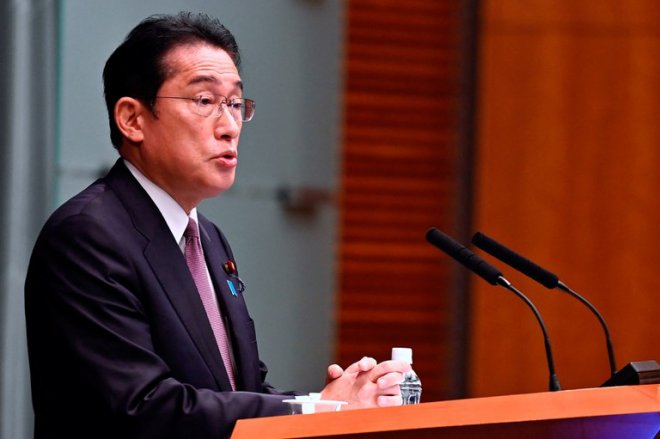 Japan"s Prime Minister Fumio Kishida attends a press conference on the National Security Strategy in Tokyo on Dec. 16, 2022. CREDIT: David Mareuil/Pool via Reuters