Bear more children – they’re like consumer durables, Chinese economist urges*
Have more children – it"s your patriotic duty. They are like durable consumer goods that you pay off over the long haul, but bring far more benefits.
That was the message from a prominent Chinese economist at a government-backed think tank, and the most recent effort by the Communist Party’s campaign to boost the country’s flagging birth rate that includes a slew of economic perks for couples – long limited to just one child – to have more children.
"Durable consumer goods pay off in the long run, so it"s wrong for young people not to have children – their value exceeds that of the other goods you buy," said Chen Wenling, chief economist at the China Center for International Economic Exchanges.
Chen’s comments sparked an online outcry. Some said that people in China are all regarded as "consumables," rather than human beings. Others said those who decide not to have children are smart.
"Today"s society has driven young people to the point of desperation," commented one social media user. "I want a place to live, but I can"t afford one. I don"t have time for fun, and I can"t afford to raise a child – this comment from this expert is so arrogant!"
Others were more cynical.
"People may be consumer goods in other countries, but here, we"re either inferior, hostages or ***holes," commented @psychotic_relapse from Shandong on Weibo.
"It"s poor thinking to treat children as private property," wrote @Gusu_Bridge from Jiangsu, while @Guangzhou_old_dog said those in power should quit making "tedious and arrogant" comments. "They should come up with some policies and test them out to see if they work in practice," the user wrote.
"Back in the 1950s, they wanted people to have more kids, then it was family planning in the 1980s, and now we"re back to encouraging people to have more kids again," wrote @My_heart_is_still_4325 from Shandong.
"But the reality is that it"s not easy to secure housing, medical care, employment or education," the user wrote, while @plants_vs_zombies_fan wrote: "Having a child in China is the worst investment."
Can’t find jobs
Chen"s comments come at a time when youth unemployment is running at around 20% in China, with around 10 million graduates about to enter the labor market to compete with those who are already unemployed.
A current affairs commentator who gave only the surname Chen agreed.
"Most people don"t have the money to find a partner right now, because all of that requires money for food, transportation and going out," Chen said. "Most young people are demotivated by that."
![]()
Job seekers visit a booth at a job fair in Beijing, Feb. 16, 2023. Credit: Reuters
"It"s not that they don"t want a partner; the economic pressures are just too huge, and far worse than before," he said.
Li Jiabao, who moved from mainland China to live in democratic Taiwan, said there is a huge amount of disillusionment with government policy from the same age group that Beijing is counting on to raise more children.
"After three years of violent enforcement of the zero-COVID policy in China, young people see this government as extremely bureaucratic and careless of human life," Li said. "I think this is the main reason why young people are so disgusted with this expert."
One-child policy
In 2016, China abandoned its 35-year “one-child policy,” which penalized parents with more than one child, amid concerns about its birth rate, raising the limit to two. In 2021, that was further loosened to three – and now there are no limits on the number of children a couple can have.
Authorities have recognized they need to offer incentives to couples to have more children amid the economic pressures of modern China.
![]()
"After three years of violent enforcement of the zero-COVID policy in China, young people see this government as extremely bureaucratic and careless of human life," says Li Jiabao, a mainland Chinese dissident who moved to Taiwan. Credit: RFA
A plan announced in August 2022 offers "support policies in finance, tax, housing, employment, education and other fields to create a fertility-friendly society and encourage families to have more children,” promising community nursery services, better infant and child care services at local level, flexible working and family-friendly workplaces, and safeguarding the labor and employment rights of parents.
But rights activists said discrimination in the workplace still presents major obstacles to equality for Chinese women, despite protections enshrined in the country"s law.
Chinese women still face major barriers to finding work in the graduate labor market and fear getting pregnant if they have a job, out of concern their employer will fire them.
And young people in China are increasingly ruling marriage out of their plans for the future, with marriage registrations falling for several years in a row.
Translated by Luisetta Mudie. Edited by Malcolm Foster.
 | 喜歡這篇嗎?快分享吧! |
前一頁
後一頁









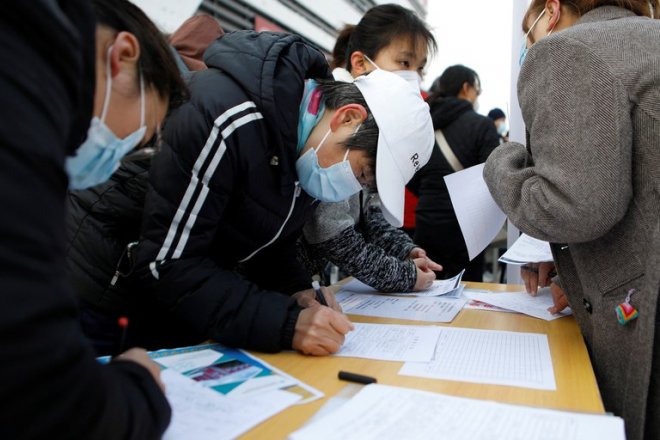 Job seekers visit a booth at a job fair in Beijing, Feb. 16, 2023. Credit: Reuters
 "After three years of violent enforcement of the zero-COVID policy in China, young people see this government as extremely bureaucratic and careless of human life," says Li Jiabao, a mainland Chinese dissident who moved to Taiwan. Credit: RFA