North Korea warns parents to send their truant kids to school*
It’s been more than 10 days since the new school year began in North Korea, and a large number of poor children have yet to show up for classes because they are needed for farm work during the planting season.
So authorities are warning their parents to send them to school or face interrogation or public shaming, sources in the country told Radio Free Asia.
Most North Korean elementary schools should have around 30 students in each classroom, but one or two from each class have yet to show up for their first day of school, a resident in the northern province of Ryanggang, who is knowledgeable about the education sector in Paegam county, told RFA’s Korean Service Monday on condition of anonymity for security reasons.
“Today, the county’s education department sent a notice to parents who have not sent their children to school … warning that they will notify the party committees and their parents’ workplaces if they don’t attend,” he said.
The warnings come after previous efforts to get the children to school failed, according to the source.
“When the class attendance rates are down, the homeroom teacher will be interrogated,” he said. “Even if their classmates come to their homes to pick them up, or if the teacher visits with the parents, there are still quite a few children who do not come to school.”
The source said that the children who aren’t attending school are from families experiencing economic hardship.
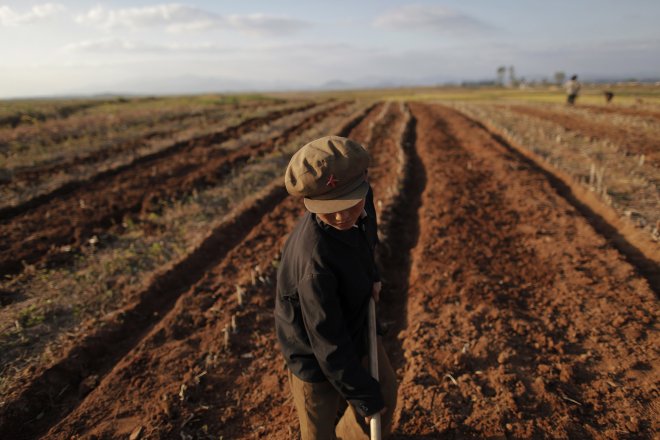
“The reason why children do not come to school is because they have to help their parents, who are busy preparing their small plots of land for farming in the mountains as the planting season begins,” he said.
Matter of survival
Planting season is vital for many rural families to survive.
“Farming on their private plots is the most important activity for the year because corn, beans, potatoes and whatever else can be grown on small plots of land will be the only food these households … have to stay alive this year,” the source said.
![]()
A North Korean boy works on a collective farm in South Hwanghae province. Credit: Reuters file photoThe same problem existed in previous years, but it fell to the teachers to ask the parents to send their kids to school, he said. This is the first year that parents are getting an official warning, and it appears to be highly unusual.
While there’s no accompanying punishment laid out in the warning other than being reported to the party committee, the potential for public disgrace by such a high-ranking institution makes the report alone a serious threat, he said.
For the country’s poorest, going into the mountains to find some empty land to grow vegetables is a matter of survival. North Korea has suffered from chronic food shortages for decades, and a suspension of trade with China during the COVID-19 pandemic made the shortages worse.
At one point during the pandemic, the government told the people that they would no longer receive rations and would be on their own for food.
The impoverished children work to cultivate the newly slashed and burned land, so they have no time to go to school.
Summoned for questioning
In the city of Kimchaek, in the northeastern province of North Hamgyong, the problem is so dire that authorities there began calling in the parents for interrogation, a source there told RFA on condition of anonymity to speak freely.
“There are a total of 28 students in my kid’s class in elementary school, but four of them are not attending,” she said. “Last week, schools in the city submitted absentee lists to the education department, and included their parents’ jobs, their titles and home addresses.”
The source said she believes that the interrogations began on Monday.
“Interrogating the parents will not guarantee a 100% attendance rate,” she said. “For families who do not have food to eat right now or who are struggling to live, it is more important to not starve than it is to send their children to school.”
Translated by Claire Shinyoung Oh Lee. Written in English by Eugene Whong. Edited by Malcolm Foster.
 | 喜歡這篇嗎?快分享吧! |
前一頁
後一頁






 A North Korean boy works on a collective farm in South Hwanghae province. Credit: Reuters file photoThe same problem existed in previous years, but it fell to the teachers to ask the parents to send their kids to school, he said. This is the first year that parents are getting an official warning, and it appears to be highly unusual.