5-year Pacific expedition hopes to find new species, establish marine protected areas*
A 5-year Pacific Ocean expedition by National Geographic has embarked from Tahiti to investigate marine life extensively, learn more about marine ecosystems, find new species and propose establishing additional protected areas.
The team is collaborating with Pacific Island nation governments, local communities, and local marine scientists to study, document and identify the potential for expanded protections in waters crucial to the survival of these countries, National Geographic said in a statement.
“Ultimately, they hope to support the establishment of new marine protected areas, each with sustainable management and financing plans,” it said.
Researchers said they will delve into the depths of the ocean to learn more about marine life, from microscopic algae to giant whales, and seek to learn more about climate change impact amid biodiversity loss, food insecurity, plastics pollution and overfishing.
“The health of the tropical Pacific is an essential need for the people who live there and really to everyone on the planet because the ocean is a key part of our life support system,” said Enric Sala, National Geographic Explorer in Residence and the founder of the Pristine Seas expedition.
Their expedition coverage region is three times the size of the United States. The first phase will cover 6,400 kilometers (3,977 miles) in 2023 alone.
The previous Pristine Seas expeditions resulted in generating more than 250 peer-reviewed scientific studies, which ultimately helped establish 26 marine protected areas worldwide.
Cutting-edge technology
The Pristine Seas tour will visit various Pacific Island countries, including Kiribati’s southern line islands, the Cook Islands, Niue, Palau, the Marshall Islands, and the Federated States of Micronesia.
On board E/V Argo, the expedition is equipped with cutting-edge technology, including a three-seater submersible vehicle that can descend to 300 meters (984 feet), drop cameras that travel six kilometers (3.7 miles) below the surface to film for hours, and a remote-controlled robot.
“So, we’re embarking on this epic journey that’s unprecedented in scope and scale,” said Alan Friedlander, the chief scientist for the expedition.
“We’re always looking for new species … A lot of the Deep Sea has never been explored in many of these places.”
![]()
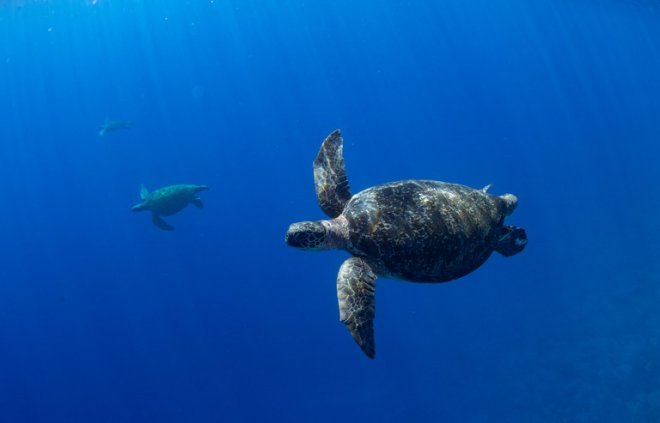
Sea turtles swimming during the past Pristine Seas expedition in October 2021. Credit: Manu San Felix, via National Geographic
An Indigenous Kiribati ocean researcher said the expedition will help understand his ocean country better “as custodians of these unique ecosystems.”
“As an Indigenous and marine scientist who grew up in a low-lying developing island state that is the front line of climate change, I have spent most of my life in the ocean, experiencing and witnessing the radical changes in the surrounding marine and ocean ecosystem,” said Evii Tong.
“It’s an existential threat to our nation, people, and culture because the ocean is our identity as I-kiribati.”
Learning from previous findings
In the Southern Line Islands, part of Kiribati, the crew will study coral reefs decimated in 2015-16 due to one of the strongest ocean warming events recorded in the tropical Pacific.
However, protected areas with fishing bans around five islands have recovered rapidly, while the unprotected reefs remain severely damaged.
The “rebirth underway in the protected zones… stands out for, so dramatically and convincingly demonstrating the link between protections and resilience,” the National Geographic said.
Their findings also showed that in protected areas, where fishing is prohibited, fish stocks have “rapidly increased by 500% or more within five to 10 years,” triggering a cascade of ecological benefits from ecosystem recovery to a boost in ecotourism.
![]()
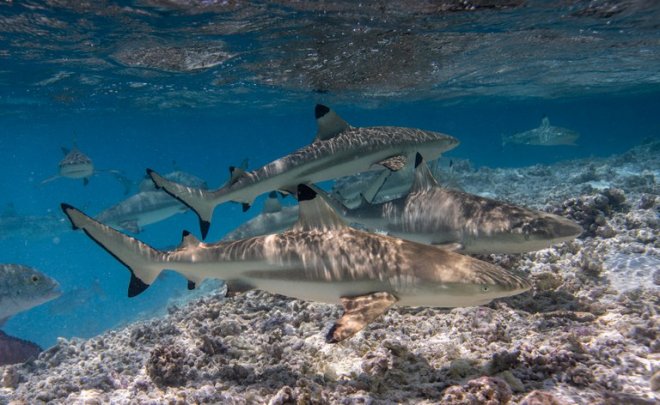
Blacktip Reef Sharks swim past a coral reef during the past Pristine Seas expedition to Kiribati’s Southern Line Islands in October 2021. Credit: Manu San Felix, via National Geographic
Another notable previous finding is the fact that sharks and other apex predators are essential to reef survival, as their voracious appetite helps in a constant turnover of life, which keeps reefs resilient to global warming stresses like coral bleaching.
Previous scientific studies missed the vital role of sharks because the work was done in easily accessible areas that had been degraded or overfished, according to Friedlander.
“We removed this bias by going to very remote regions … and showing how a truly pristine, healthy ocean environment functions,” he said.
Also, for the first time, the expedition showed the amount of carbon released every year due to seafloor net dragging, or “bottom trawling,” a fishing practice, equals the amount generated by the aviation industry.
Study of controversial deep-sea mining
The expedition will investigate deep-sea mining, a contentious issue in the region that has currently divided the Pacific Islands countries into two opposite camps.
Sala said specialized cameras will capture detailed depictions of the underwater ecosystems in some of the proposed areas for deep-sea mining, which is “a serious threat to that rich and fragile marine life of the depths.”
“We believe that we should know more; the world should not rush to mine the deep sea until we know enough about this part of the world, the last frontier,” he said.
![]()
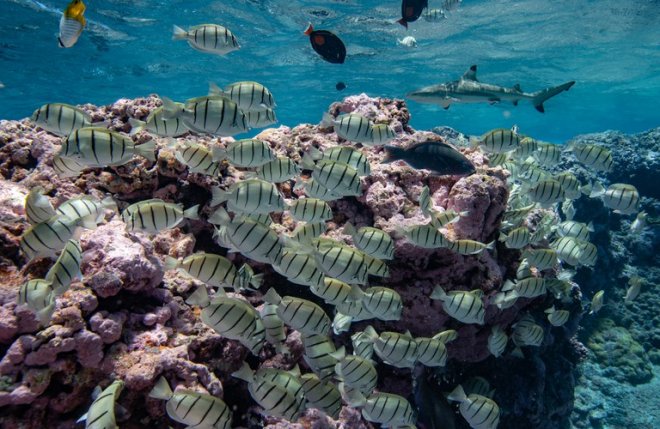
Convict Tang fish seen in a photo taken during the past Pristine Seas expedition to study how remote atolls fared during mass coral bleaching in Kiribati’s Southern Line Islands in October 2021. Credit: Manu San Felix, via National Geographic
Palau’s Agriculture, Fisheries and Environment Minister, Steven Victor, said the expedition would “provide a glimpse into the ocean depth that we often have very little appreciation for because we don’t know what’s there.”
“We are an ocean people and culture ... We as Pacific Islanders have taken responsibility to take care of the ocean, and we call on the rest of the world to share that responsibility with us,” he said.
Last week, Palau President Surangel Whipps Jr. told Radio Free Asia that his government has asked for a deep-sea mining moratorium, at least until 2030.
“As a Pacific Islander whose islands are going under, why would you go scrape the bottom of the ocean and release carbon, which we’re … trying to stop? So that’s being hypocritical,” he said.
“Ultimately, one man’s gain can be the demise of the other, and that’s why I said let’s not let greed lead.”
Edited by Mike Firn.
 | 喜歡這篇嗎?快分享吧! |
前一頁
後一頁










 Sea turtles swimming during the past Pristine Seas expedition in October 2021. Credit: Manu San Felix, via National Geographic
 Blacktip Reef Sharks swim past a coral reef during the past Pristine Seas expedition to Kiribati’s Southern Line Islands in October 2021. Credit: Manu San Felix, via National Geographic
 Convict Tang fish seen in a photo taken during the past Pristine Seas expedition to study how remote atolls fared during mass coral bleaching in Kiribati’s Southern Line Islands in October 2021. Credit: Manu San Felix, via National Geographic