ANALYSIS: China's ruling party launches political campaign likely to lead to purges*
The ruling Chinese Communist Party looks set to embark on a Mao-style political campaign to tease out opposition to Xi Jinping and his personal brand of ideology, calling for nationwide opinion-gathering with a view to "rectification," analysts said on Monday.
The Central Committee"s general office, which runs the party on a day-to-day basis, called on party members in all regions and departments to mobilize as part of a nationwide drive to "rectify" the party"s work, a phrase also used by late supreme leader Mao Zedong in the 1940s and 1950s to launch a series of purges within party ranks.
Mao used "rectification" campaigns starting when the Communist Party was still fighting a civil war against the Kuomintang government of Chiang Kai-shek from its base in Yanan to correct "deviations" in party ideology.
Under Xi, the move will likely herald a mass intelligence-gathering drive followed by purges of members unwise enough to voice discontent with the current political line, according to political commentators.
"We must adhere to the party"s mass line, come from the masses, go to the masses, enhance the relationship with the masses, sincerely listen to the voices of the masses, truly reflect the wishes of the masses, genuinely care about the sufferings of the masses, and consciously learn from the masses," the general office said in a directive published in the
People"s Daily newspaper on March 20.
"We must persevere in overcoming difficulties, carry forward the spirit of struggle, strengthen our ability to fight and bravely venture into dangerous territory," it said.
‘Privileged attitudes’ targeted
According to the document, one focus of the campaign will be to "ensure the security of food, energy, the industrial supply chain, production [and] the supply of [pharmaceuticals]."
Another will be "guiding news and public opinion [and] the comprehensive governance of the internet."
"Bureaucratic thinking, privileged attitudes and behavior," will also be targeted, the directive said.
"It will be necessary to go deep into grassroots units like rural areas, residential communities, enterprises, hospitals, schools, new economic organizations, and new social organizations ... to find gaps in our work," it said.
![]()
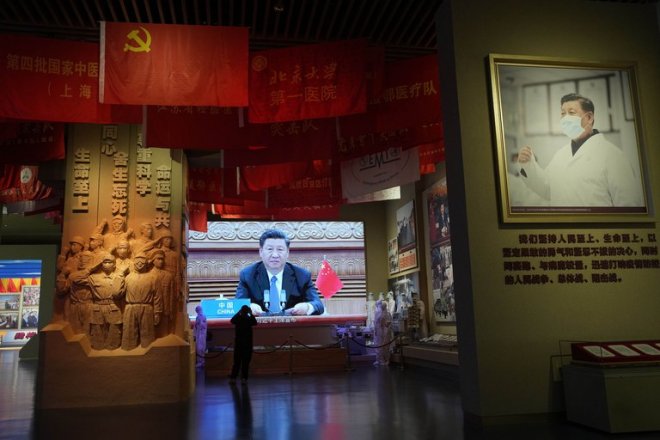
In this Oct. 12, 2022 photo, Chinese President Xi Jinping is seen on screen and poster at an exhibition highlighting China"s fight against the COVID-19 pandemic at the Museum of the Community Party of China in Beijing. (Ng Han Guan/AP)
A current affairs commentator who gave only the surname Song for fear of political reprisals said the call to hear opinions and carry out research among "the masses," sounded much like the rhetoric put out under Mao in the late 1950s, which was used to identify people who disagreed with the party line, so they could be purged in "the spirit of struggle," now a buzzword under Xi.
"Just like Mao Zedong tempted the snake out of the hole in 1957, they want dissenting voices to speak out through normal channels, so they can figure out who is unhappy with current policies," Song said.
"Several leaders including [party ideologue] Wang Huning have emphasized the need for "struggle" in recent speeches to the Chinese People"s Political Consultative Conference," he said.
‘Everything is from top down’
Song said there is an extreme version of top-down governance now in place in China, following institutional reforms that have concentrated the day-to-day running of scientific and technological research, financial markets and data centers in the hands of the most powerful officials in China under the control of Xi.
"Everything is governed by a single person -- everything is from the top down," Song said. "I don"t think this will do China"s economy or political environment any good at all."
Current affairs commentator Chen Pokong said Xi has emerged victorious with a third and indefinite term in office following the 20th party congress last October and the National People"s Congress annual session earlier this month.
"The Xi faction seized power in a comprehensive way, establishing the dominance of a single faction, and the dictatorship of a single person," Chen wrote in a recent commentary for RFA Mandarin.
"[They] broke with the system of term limits and collective leadership of the economic reform period in one fell swoop."
‘Stalinist tactics’
Chen said Xi is extremely good at winning power struggles within the party.
"Xi Jinping ... is extremely diligent when it comes to power struggles, devoting every hour in every day, every day in every week, month and year to tactics and power struggles without let-up," Chen wrote.
"[He] employs Stalinist tactics to seize power ... installing his cronies in key positions of power over 10 years, including the general office, the party organization department, the central propaganda department, the ministry of state security and the ministry of public security, which fell under his control one after the other," Chen said.
Xi set up a secret service bureau under his trusted ally Wang Xiaohong to monitor other political elders and hold them under house arrest, neutralizing opposition at the highest echelons before it even had a chance to emerge, he wrote.
"By carefully selecting, arranging and rotating guards, secretaries, assistants, drivers, cooks, nurses and other personnel, he was able to achieve strict monitoring and control of political elders and his political rivals within the party," Chen said.
He said Xi"s power grab had been enabled by and inspired by the fall of jailed former Chongqing party chief Bo Xilai following rumors that he had been engaged in a coup plot along with jailed former security czar Zhou Yongkang.
Hubei resident Sun Shuli said the party general office directive reads like the beginning of another political campaign.
"It feels like they want to consolidate party power, ensure loyalty, and also to wage a political campaign," Sun told Radio Free Asia.
Translated by Luisetta Mudie. Edited by Malcolm Foster.
 | 喜歡這篇嗎?快分享吧! |
前一頁
後一頁






 In this Oct. 12, 2022 photo, Chinese President Xi Jinping is seen on screen and poster at an exhibition highlighting China"s fight against the COVID-19 pandemic at the Museum of the Community Party of China in Beijing. (Ng Han Guan/AP)