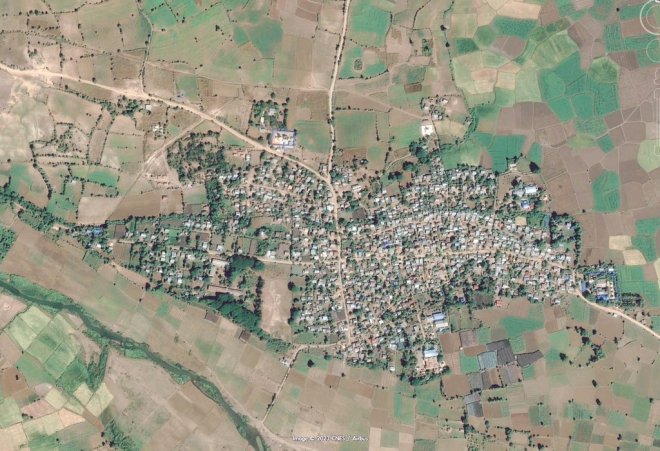
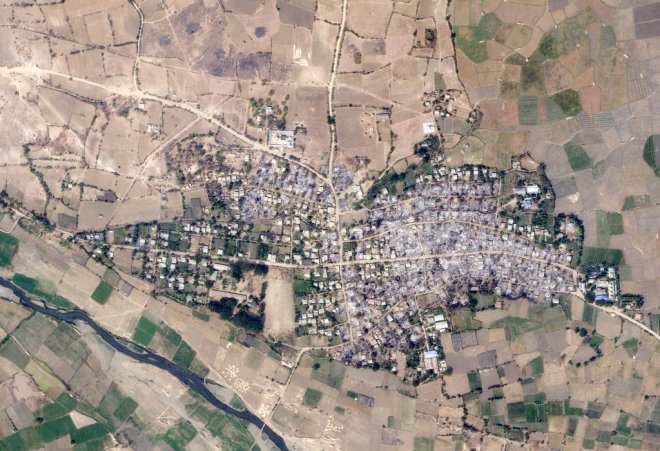
and March 4, 2023. The second image was taken days after junta troops torched the village. Credit: Google Earth CNES/Airbus
and Planet LabsThe report documents a long list of human rights violations from Feb. 1, 2022, to Jan. 31, 2023, alone amid what it said was a “sharp rise in violence” over the past year – particularly in the country’s northwestern and southeastern regions.
It cited credible sources as having confirmed the military’s killing of at least 2,940 civilians and arrest of 17,572 others since the coup. The Assistance Association of Political Prisoners (Burma), an NGO based in Thailand, puts the numbers higher, with at least 3,110 killed and 20,167 arrested.
Central to the military’s impact on Myanmar’s civilian population is its so-called “Four-cuts approach” against the armed resistance, the report found. This included indiscriminate airstrikes and shelling, razing of villages, and denial of humanitarian access as part of a bid to “cut off” anti-junta forces from access to food, finances, intelligence and recruits.
The military launched 301 airstrikes in 2022, compared to 125 a year earlier, fired heavy artillery shells 756 times, compared to 376 times in 2021, and burned civilian villages 1,355 times – a staggering five-fold increase from its 282 arson attacks the prior year.
The report singled out the systematic and widespread burning of villages and dwellings as one of the military’s most frequently used tactics, noting that nearly 39,000 houses across the country have been burnt or destroyed by junta troops since February 2022 alone – a more than 1,000-fold increase from a year earlier.
Of the country’s regions, Sagaing was the most affected, with more than 25,500 homes destroyed by military arson, the U.N. said. The military razed nearly the entire village of Ah Shey See in Sagaing’s Kale township, burning 621 structures to the ground, the report found, based on an analysis of satellite imagery.
Civilians in the crosshairs
The military’s indiscriminate airstrikes do more harm to the civilian population than its enemies, the commander of an anti-junta People’s Defense Force paramilitary group in Chin state’s Kanpetlet township told RFA Burmese, speaking on condition of anonymity out of security concerns.
“The military airstrikes target our bases but they often misfire and hit civilian populations, causing the people to suffer,” he said.
A resident of Kawkareik township in southeastern Myanmar’s Kayin state told RFA that not even civilians who flee attacks on their villages are safe from the military.
“People fleeing to the jungle have no shelter and have to live with what little they can carry, under [makeshift] roofs made of leaves,” said the resident. “The military troops still target and shoot at them, as if [the shelters are] an enemy base.”
The U.N. report also documented at least 24 mass killings by junta troops of five people or more in 2022 alone.
The reported increase in the targeting of civilians comes despite numerous claims by junta Deputy Information Minister Major Gen. Zaw Min Tun during interviews with RFA that the military does not target noncombatants or commit arson attacks.
Meanwhile, Myanmar’s economy has foundered as the result of military mismanagement, doubling the country’s poverty rates from March 2020.
The U.N. Human Rights Office said in its report that nearly half of the population now lives in poverty, while rural populations risk starvation amid military restrictions in conflict zones. Some 17.6 million people are being denied access to crucial humanitarian aid, it said.
![]()
Junta troops torched Kone Ywar village, Yinmarbin township, in Myanmar’s Sagaing region on March 1, 2023. When the flames finally died down by Wednesday morning, they methodically set fire to whatever was left standing. Credit: Citizen journalistCommissioner Türk accused the military of creating a “perpetual human rights crisis” in Myanmar since the coup.
“Across Myanmar, people are continuously exposed to violations and crimes, including killings, enforced disappearances, displacement, torture, arbitrary arrests, and sexual violence,” he said.
“There are reasonable grounds to believe that the military and its affiliated militias continue to be responsible for most violations, some of which may constitute crimes against humanity and war crimes.”
The U.N. report called for an immediate halt to the violence in Myanmar, the release of those arbitrarily detained, accountability, and unhindered humanitarian access.
Call for immediate action
Speaking to RFA, Nay Phone Latt, the spokesperson for the office of shadow National Unity Government Prime Minister Duwa Lashi La, welcomed the U.N. report, but called for immediate and concrete action to stop the junta.
“This is a situation where tens of people are killed by the junta every day, and their homes and property are being destroyed on a daily basis, as well,” he said.
“Time is of the essence. The longer action is delayed, the more innocent civilians will suffer. That’s why we need to determine the root causes, choose the right methods to deal with them, and implement them quickly.”
Kyaw Win, director of the Burma Human Rights Network told RFA that the military’s human rights violations do more than “constitute” crimes against humanity, calling them even worse than what is documented in the U.N. report.
“What the Myanmar military is carrying out are crimes against humanity … because it has systematically committed such crimes everywhere using the same pattern and methods,” he said.
Other sources said they were unsurprised by the U.N.’s findings, noting that the military has become increasingly brutal over the two years since the coup.
“If such atrocities continue to happen every month, the people will be in serious trouble,” said a member of the PDF in Sagaing’s Wetlet township, who also declined to be named. “The international community must join together to overthrow the military regime as soon as possible.”
Translated by Myo Min Aung. Edited by Joshua Lipes and Malcolm Foster.
 | 喜歡這篇嗎?快分享吧! |
前一頁
後一頁










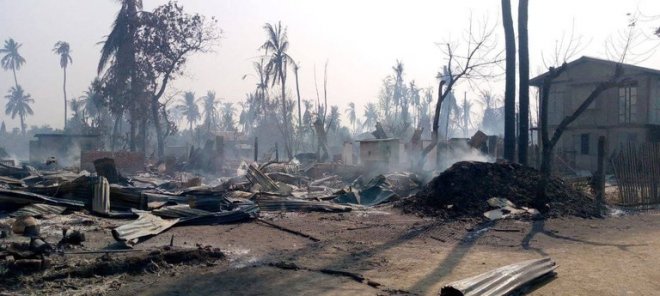 Junta troops torched Kone Ywar village, Yinmarbin township, in Myanmar’s Sagaing region on March 1, 2023. When the flames finally died down by Wednesday morning, they methodically set fire to whatever was left standing. Credit: Citizen journalistCommissioner Türk accused the military of creating a “perpetual human rights crisis” in Myanmar since the coup.