Back-to-back patriotic February holidays prove exhausting ordeal for North Koreans*
North Koreans have come to dread February because of back-to-back patriotic holidays that require them to attend a seemingly endless stream of propaganda lectures, political events and commemorative performances in the days leading up to them, sources in the country tell Radio Free Asia.
Feb. 8 is the anniversary of the formation of the Korean People’s Army, which this year ended with a huge military parade in Pyongyang.
As soon as that’s over, preparations begin for the next holiday eight days later, the “Day of the Shining Star” – the Feb. 16 birthday of Kim Jong Il, the father of current leader Kim Jong Un.
Outwardly, propaganda images show the faces of determined, happy people expressing their devotion to their leaders at these events, but privately many people complain bitterly about the grueling meetings and see it as a huge waste of time.
“They wish instead that the holidays would disappear,” a resident in the northeastern province of North Hamgyong told RFA’s Korean Service.
“Residents have had exhausting, hectic schedules since the end of last month with all these events, meetings and military support projects related to Army Founding Day to the extent that they cannot sleep well at night,” he said.
Then leading up to the Feb. 16 holiday, all schools, companies and public organizations are forced to practice for hours for a “Songs of Loyalty” competition.
On Kim Jong Il’s birthday itself, workers and government officials are required to attend numerous events that stretch late into the night, including an hour-long “commemorative large-scale briefing session,” a separate commemorative lecture and artistic performances by personnel from each organization, according to the source
“I don’t think they will be able to go home until very late at night,” the source said. “The workers say that they do not know why the authorities are forcibly organizing such meaningless events and shows that no one is interested in.
Growing resentment
In nearby Ryanggang province, workers had to attend all the customary gatherings and performances, and even field teams for sports events.
“These workers are so tired of all these political meetings and commemorative events. They have not been able to take a full day off because of these two consecutive holidays this month,” a Ryanggang resident told RFA on condition of anonymity to speak freely.
![]()
Pyongyang citizens watch a performance by an art squad on the occasion of the 81st birth anniversary of Kim Jong Il in Pyongyang, North Korea, Feb. 16, 2023. Credit: APAs people have grown more resentful of being forced to celebrate, the officials in charge of them became uncomfortable because there was nothing they could say to end the constant complaints, according to the second source.
“Each company must be seen preparing effectively or else the companies could face disadvantages later,” the second source said. “The officials have no choice but to burden their workers,” the source said.
Hit to income
The holidays are not only physically difficult for people because they must be present at all the events, participation hurts their bottom line, because it prevents them from running their family businesses.
Side businesses are the only actual means of support for most North Koreans because salaries for government assigned jobs haven’t been enough to live on since the country’s economy collapsed following the fall of the Soviet Union in the 1990s.
The men must all show up for work, so in most families it is the women who mind the market stalls, buying and selling living necessities to earn what they can.
“These days, more households are struggling to make ends meet because the women from many households do not have time to make a living because they are participating in events all day long,” the second source said.
“The residents … criticize the authorities, saying they don’t understand why they organize these events to make the peoples’ lives harder.”
Translated by Claire Shinyoung Oh Lee and Leejin J. Chung. Edited by Eugene Whong and Malcolm Foster.
 | 喜歡這篇嗎?快分享吧! |
前一頁
後一頁




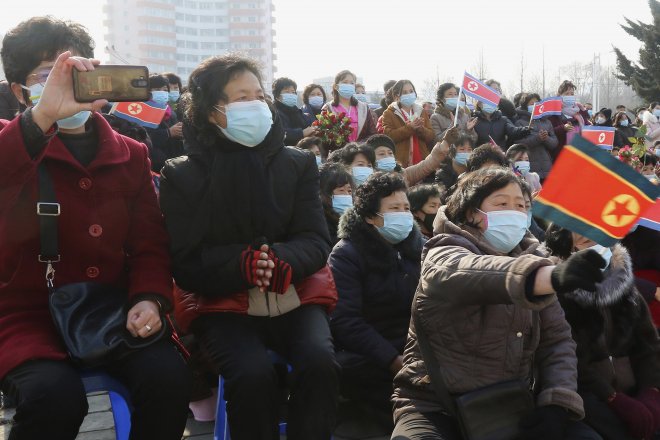 Pyongyang citizens watch a performance by an art squad on the occasion of the 81st birth anniversary of Kim Jong Il in Pyongyang, North Korea, Feb. 16, 2023. Credit: APAs people have grown more resentful of being forced to celebrate, the officials in charge of them became uncomfortable because there was nothing they could say to end the constant complaints, according to the second source.