Illegal trade of pangolins and their parts widespread online in Laos*
Wildlife traders say that the illegal trade of pangolins remains strong – including on the Internet – despite their listing as a critically endangered species by Laos and even though the government has ordered a crackdown on the trade of endangered wildlife.
The armadillo-like anteaters, also known as scaly anteaters because of their protective scales, are about the size of a house cat or small dog, and are a threat to no one except to ants and termites, which they lap up with a long, sticky tongue.
Many citizens in China, Vietnam and Hong Kong believe that pangolin scales have medical uses. But experts, even including some of China’s traditional medicine practitioners, say that no scientific evidence supports this belief.
Laos, a popular transit hub for the illegal wildlife trade of animals and their parts or products, is one of the top countries worldwide for the illegal pangolin trade.
“Most of us are middlemen who buy pangolins and their scales from other countries then sell them to China and Vietnam,” said one pangolin scale trader in northern Laos, who like all other sources in this report requested anonymity for safety reasons.
![]()
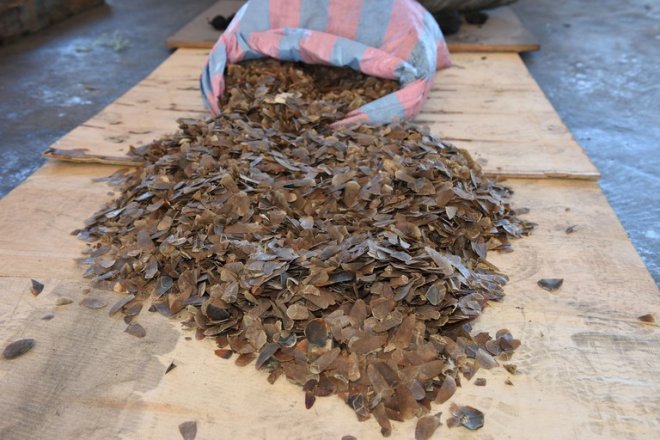
These pangolin scales were seized by Chinese customs officials from a ship in Shenzhen, Guangdong province, China, in 2017. Credit: Reuters
Because Laos has captured and sold most of its pangolins, traders in the country mostly buy their scales from Thailand and Myanmar, the trader said. But there is still a small market for live pangolins in Laos.
A kilogram worth of pangolin scales has risen to between 6,000 and 8,000 Thai baht (U.S.$173 and $230), the trader said.
Markets in China and Vietnam
There are two markets. Buyers in China want mostly live pangolins while those in Vietnam want only scales, according to another trader who is located in Vientiane province. A live pangolin is worth about a half million kip (U.S.$30), he said.
“Right now, we mostly buy and sell pangolins and their scales online like on Facebook,” he said. “We’d negotiate the prices then transfer money to each other. The sellers would send the products through the post office.”
A statement on the U.S. Embassy’s Facebook page on Feb. 18 – World Pangolin Day – called pangolins the most trafficked mammal in the world.
Laos is a party to the international Convention on International Trade in Endangered Species, or CITES, a multilateral treaty protecting endangered plants and animals, and has a domestic aquatic and wildlife law. In 2018, the prime minister directed provincial governors across Laos to take firm action concerning the enforcement of both CITES and the national wildlife law.
An official from the Agriculture and Forestry Department of Oudomxay Province in northern Laos, near China said that they sometimes arrest pangolin smugglers.
“Oudomxay Province is a transit point. The smugglers pass our province before going to Luang Namtha Province and then to China,” the official said. “But pangolin smuggling has been down since the start of the COVID-19 pandemic. Illegal trade is now conducted online.”
An official of the Agriculture and Forestry Department of Khammouane Province in southern Laos said the government is in the process of setting up a task force to crack down on the online wildlife trade.
Translated by Max Avary. Edited by Matt Reed and Malcolm Foster.
 | 喜歡這篇嗎?快分享吧! |
前一頁
後一頁










 These pangolin scales were seized by Chinese customs officials from a ship in Shenzhen, Guangdong province, China, in 2017. Credit: Reuters