In bid to boost childbearing, North Korea offers sporadic extra food*
As North Korea’s birth rate declines amid chronic food shortages, authorities are offering families with three or more children extra food twice a year, on the birthdays of the country’s former leaders.
But people complain that the additional food – 20 kilograms (44 pounds) of corn, two kilograms of fermented soybean paste and a bottle of cooking oil – is hardly enough to get them to even think about having more kids, sources inside the country tell Radio Free Asia.
“It’s hard for most women to make ends meet just for themselves these days. So who in her right mind would have three or more children, like a fool?” said a source in North Pyongan’s Ryongchon county. “If the authorities want women to have more kids, they need to solve the problem of food and livelihood.”
A declining birth rate spells doom for a country which relies heavily on raw manpower by forcing all men to serve seven years, and all women five, in its 1.3 million-strong military. The military is not only for defense; soldiers spend much of their service time doing manual labor in construction, mining, and on collective farms.
Fewer people would mean fewer hands to build, plant, harvest, and dig, in a country that is still struggling to develop. This is why the government is, at least nominally, rewarding families with multiple children–to ensure the population remains stable.
![]()
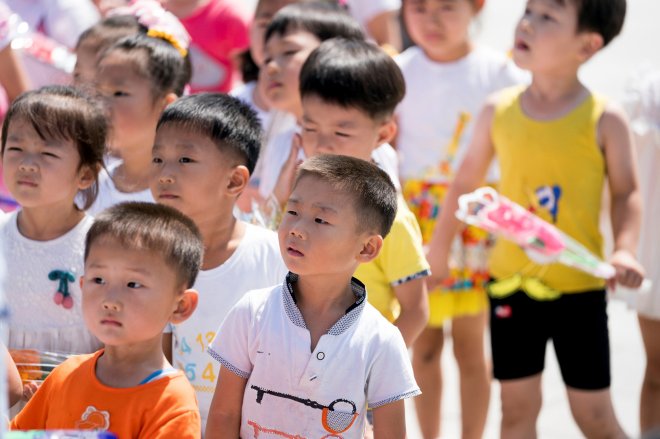
Children arrive to pay their respects in front of bronze statues of the late North Korean leaders Kim Il Sung and Kim Jong Il at Munsu Hill in Pyongyang, North Korea. Credit: Pool via Reuters file photo
A family is given multiple child status if they have three or more children who have yet to graduate from high school, the source said. Only 20 families qualified in his town, which has about 6,000 households.
This is in addition to a monthly stipend of 60 U.S. cents from the state each month, which hardly makes a difference.
Multi-child families in South Pyongan’s Unsan county received the same gift of corn, bean paste and oil, and residents had a similar reaction, a source there told RFA.
Plus, the extra food usually comes only twice a year, around two holidays – the Feb. 16 birthday of Kim Jong Il, the father of current leader Kim Jong Un, and national founder Kim Il Sung, his grandfather, on April 15.
“They demand that women have many children, but the residents gripe that these kinds of extra food supplies happen only every once in a while,” said the source.
Still ahead of Japan and South Korea
North Korea’s birth rate is about 1.8 children per woman – just below the replacement level of 2.1 births, according to World Bank data for the year 2020.
That was higher than the birth rate in neighboring South Korea, which was the lowest in the world at 0.8, or Japan, where it was 1.3. Those countries governments have enacted policies to encourage young adults to have children, including guaranteed parental leave for both mothers and fathers, stipends for new parents that increase with more children and preferential placement in childcare facilities for families with more children.
Authorities in South Korea have even encouraged companies to let their workers go home at reasonable hours on designated “Family Days,” so they could have time to make babies.
But these efforts have proven largely ineffective, and birth rates both countries remain low.
In North Korea, authorities hope some extra food might do the trick – an “absurd” expectation, the second source said.
They are trying to send a message that women who give birth and raise many children will receive preferential treatment in society in the future, including monthly supplies of food, she said.
“Authorities are encouraging women to have more children on false premises,” the second source said. “They lie to them that multi-child households will be supplied with food every month from the national preferential supply.”
Translated by Claire Shinyoung Oh Lee and Leejin J. Chung. Edited by Eugene Whong and Malcolm Foster.
 | 喜歡這篇嗎?快分享吧! |
前一頁
後一頁




 Children arrive to pay their respects in front of bronze statues of the late North Korean leaders Kim Il Sung and Kim Jong Il at Munsu Hill in Pyongyang, North Korea. Credit: Pool via Reuters file photo