UN efforts in Myanmar fail in implementation: Shadow government, aid groups*
Myanmar’s shadow government and aid groups have welcomed the United Nations’ efforts to assist millions amid widespread armed conflict in the country, but say they must be better implemented if they are to be effective.
The U.N. Office for the Coordination of Humanitarian Affairs (UNOCHA) recently announced that 17.6 million people, or nearly one-third of Myanmar’s population of 55 million, need humanitarian assistance two years after the military seized power in a coup. In the 24 months since the coup, the number of people displaced by conflict had grown to 1.5 million, up from 1.2 million in January this year, it said.
But while the U.N. provided aid to some 4 million people across the country in 2022, it said that ongoing conflict, airstrikes, and tightened security have severely hampered the ability of its agency and other organizations to provide humanitarian assistance.
Win Myat Aye, minister of Humanitarian and Natural Disaster Management for Myanmar’s shadow National Unity Government, acknowledged the difficulties in providing assistance amid widespread conflict, but said U.N. needs to do a better job.
“UNOCHA’s statistics for the previous year of 2022 show its humanitarian assistance programs were not effective,” he told RFA Burmese.
“We have seen that its programs are mainly concentrated in the Yangon region [where conflict is less pronounced] and they cannot provide aid effectively to other regions where the need for humanitarian aid is urgent. We conclude its programs were not able to provide aid effectively.”
UNOCHA’s own reporting found that at least 4.5 million of those in need of assistance are from Myanmar’s more remote conflict areas, with women accounting for 52%, children for 32%, and the disabled for 12% of the total.
The agency said at the end of January that U.S.$764 million had been earmarked for an emergency assistance program through the country’s humanitarian aid community, and that priority would be given to the 4.5 million people in conflict areas.
But Banyar, the director of the ethnic Karenni Human Rights Group, told RFA that while he appreciates UNOCHA’s work, he doesn"t see it as adequate.
“I am particularly unsatisfied with what they have done for IDPs in Kayah state,” he said.
“They only provide aid in the areas where the junta has given them permission. Their work is also entirely compliant to junta restrictions.”
From bad to worse
Sources in areas that have seen some of the worst fighting between the military and the armed resistance told RFA that the situation had gone from bad to worse, particularly for those displaced by violence.
“We are always on the run, so I don’t have a job and can’t make any money,” said one woman in Sagaing region’s Salingyi township, who spoke to RFA on condition of anonymity citing fear of reprisal.
“I have two kids, but I have never received any assistance. As I am running with the kids, I have to spend additional money for their nutrition. When I fled home this time, I didn"t have a dime as I had no income.”
![]()
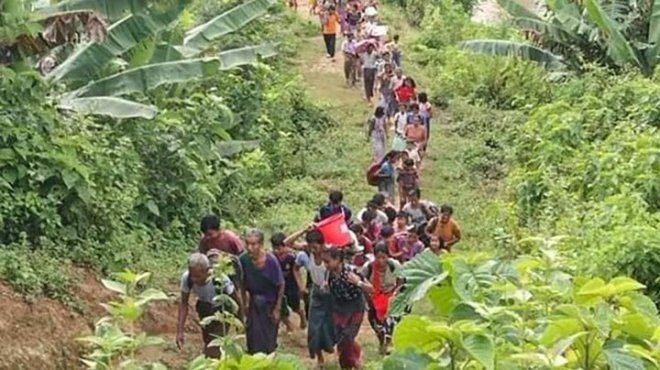
Refugees in Matupi township in Myanmar’s Chin state make their way through the woods in 2022. Credit: Matupi Revolution News
![]()
More than 10,000 people from nearly 20 villages in Salingyi have fled their homes since the military began a clearance operation in the township on Feb. 4.
Another displaced woman in northern Shan state’s Kutkai township told RFA that fighting in the region had caused the price of basic commodities to soar in recent months.
“The price for rice is up significantly as we speak,” she said. “We have faced more and more hardships in life. We can barely make ends meet to provide for our families.”
‘A challenging situation’
A woman who fled fighting in Chin state’s Mindat township told RFA that her group is facing severe shortages, with many women and children among them.
“In some places there are no clinics, but even when there is a clinic, they don’t have enough medical supplies, so we have to travel to the city to get medicine,” she said.
“The IDP (internally displaced persons) camps and the officials accepting IDPs cannot provide medical care or medicine. Now, IDPs are required to find medical care using their own funds. So, we are facing a challenging situation.”
The Chin Human Rights Organization told RFA that at least 52,000 people from Chin State have fled across the border to India’s Mizoram state since the military coup.
When asked about delays to its emergency aid program for 2023, a UNOCHA representative told RFA in an emailed response that the agency is “working to start the process.”
According to independent research group ISP-Myanmar, as of Jan. 20, there had been at least 8,100 incidents of conflict in Myanmar since the coup – nearly double the number in the decade prior to the takeover.
Thailand’s Assistance Association for Political Prisoners (AAPP) said that authorities in Myanmar have killed 2,988 civilians and arrested more than 19,000 others since the coup, mostly during peaceful anti-junta protests.
Translated by Ye Kaung Myint Maung. Edited by Joshua Lipes.
 | 喜歡這篇嗎?快分享吧! |
前一頁
後一頁










 Refugees in Matupi township in Myanmar’s Chin state make their way through the woods in 2022. Credit: Matupi Revolution News
 More than 10,000 people from nearly 20 villages in Salingyi have fled their homes since the military began a clearance operation in the township on Feb. 4.