Hong Kong police got more than 400,000 tips last year on national security hotline*
Hong Kong police received more than 400,000 tip-offs last year to a hotline for reporting violations of a draconian national security law criminalizing public criticism of the authorities, suggesting a brisk trade for political informants.
Police Chief Raymond Siu said clamping down on crimes under the law will remain the top priority for the city"s police, who were widely criticized for violence against mostly unarmed protesters in 2019, amid a mass movement against the loss of Hong Kong"s traditional freedoms under Chinese rule.
By the end of December 2022, police had arrested 236 people under the law and charged more than 140 of them, Siu told journalists.
"Our priority is to continue to safeguard national security and engage the whole community to counter terrorism," Siu said. "We have to guard against the threat of extreme violence of home-grown terrorism that is going underground."
He said the national security and "counter-terrorism" hotlines would continue to play a key role. "Citizens should notify the police as soon as possible if they find anything suspicious," Siu said.
"Police will keep trying to improve intelligence gathering and proactively raise public ... awareness and responsiveness towards terrorist incidents through different media and activities," Siu said, but gave no details of specific "terrorism" cases.
In July 2021, a Hong Kong court convicted motorcyclist Tong Ying-kit of "terrorism" and “secession,” handing him a nine-year prison sentence for flying a banner carrying the banned slogan "Free Hong Kong! Revolution now!" at a protest.
Atmosphere of fear
Barrister and former lawmaker Dennis Kwok said the number showed just how many people were willing to help create an atmosphere of fear in Hong Kong.
"This figure is absolutely incredible," Kwok said. "If they have had 400,000 tip-offs, that means at least a few thousand a day on average."
"If there really are so many people endangering national security, then why isn"t the government enforcing this law?" he asked.
![]()
"If they have had 400,000 tip-offs, that means at least a few thousand a day on average," says barrister and former Hong Kong lawmaker Dennis Kwok. Credit: AFP file photo
Forty-seven former opposition politicians and activists are currently standing trial for "subversion" under the law after they took part in a democratic primary aimed at maximizing the number of opposition seats in the 2020 Legislative Council elections.
Former pro-democracy lawmaker Ted Hui said the hotline also accepts reports from informers around the world, as the national security law applies to acts and speech anywhere in the world that are deemed to be “secession,” “subversion of state power,” “terrorist activities,” or “collusion with foreign powers to endanger national security."
"The whole situation is worrying," Hui said. "The scope of the national security law is not limited to Hong Kong, but applies overseas, and not just to Hong Kongers."
"Anyone who criticizes the Hong Kong government or holds critical or dissenting opinions could be affected by the fear of informants, which is partly the intention of the [ruling Chinese Communist Party] regime," he said.
"A lot of Hong Kongers have emigrated overseas, so they are using these informant hotlines to create invisible tensions, threatening those who continue to speak out overseas," he said.
Mass exodus
Hong Kong has seen an exodus of middle-class professionals in the wake of the crackdown on the 2019 pro-democracy movement, which called for fully democratic elections but instead was rewarded with changes to the electoral rules preventing pro-democracy candidates from running at all.
The British government has accused Beijing of failing to fulfill its promises made in the 1984 Sino-British Joint Declaration governing the 1997 handover to Chinese rule, in which China promised to let Hong Kong people rule Hong Kong and to maintain the city"s traditional freedoms for at least 50 years.
![]()
"The whole situation is worrying," says Ted Hui, a former pro-democracy lawmaker in Hong Kong, "The scope of the national security law is not limited to Hong Kong, but applies overseas, and not just to Hong Kongers." Credit: Reuters file photo
"Twenty-five years on from the handover, the Chinese and Hong Kong authorities are undermining the rights and freedoms promised to Hong Kongers under the Sino-British Joint Declaration," the Foreign, Commonwealth & Development Office said in a six-monthly report on the status of Hong Kong last month.
"Hong Kong’s autonomy is declining, and the pervasive, chilling effect of the National Security Law seeps into all aspects of society," the report said.
For its part, China has accused British and U.S. officials of interfering in its internal affairs, claiming that "hostile foreign forces" have been trying to foment a "color revolution" in Hong Kong through successive waves of mass protests in recent years.
Beijing recently appointed hard-line former security chief Zheng Yanxiong, who made his name cracking down on the rebel Guangdong village of Wukan amid a bitter land dispute in 2011, as its new envoy in the city.
Translated by Luisetta Mudie. Edited by Malcolm Foster.
 | 喜歡這篇嗎?快分享吧! |
前一頁
後一頁








 "If they have had 400,000 tip-offs, that means at least a few thousand a day on average," says barrister and former Hong Kong lawmaker Dennis Kwok. Credit: AFP file photo
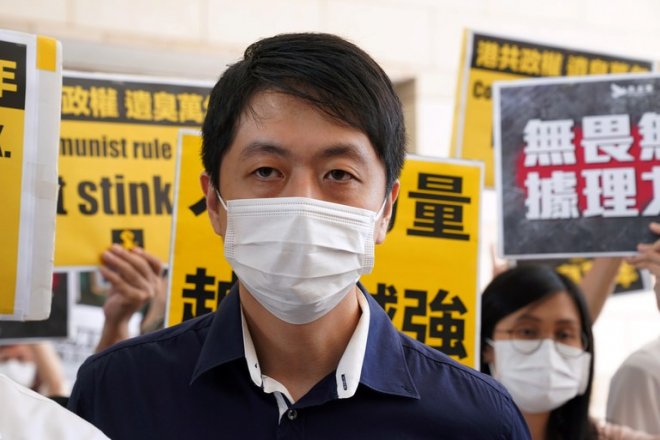 "The whole situation is worrying," says Ted Hui, a former pro-democracy lawmaker in Hong Kong, "The scope of the national security law is not limited to Hong Kong, but applies overseas, and not just to Hong Kongers." Credit: Reuters file photo